
Grout Calculator
Grout needs depend less on the room size than on the tiles: small mosaics with wide joints can use ten times as much grout per square foot as large-format tiles with tight joints. This calculator uses the standard joint-volume formula to estimate grout by weight and bags, and the guide explains joint widths, sanded and unsanded grout, and how to avoid running short mid-job.
- Free to use
- No sign-up
- Runs in your browser
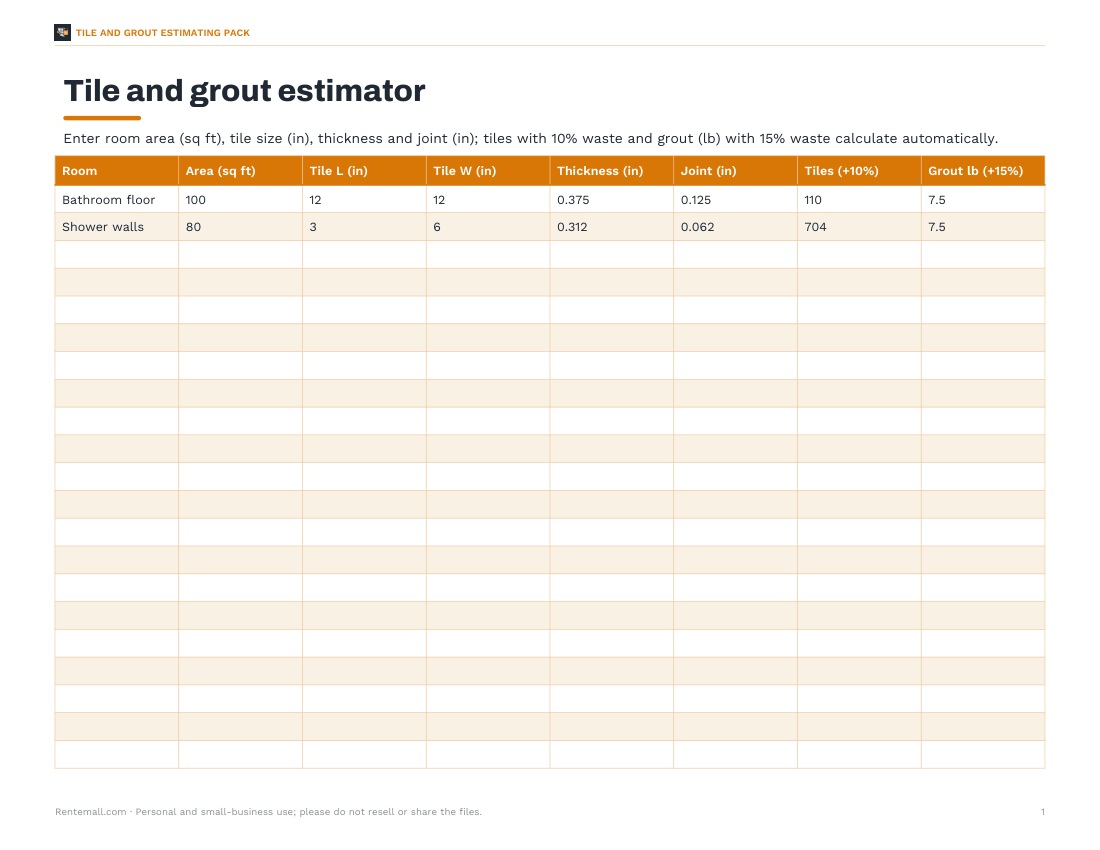
Grout calculator
Tile and Grout Estimating Pack
Excel tile, adhesive and grout estimator for multiple rooms, a printable tiling checklist, a grout colour and batch record and a project cost log.
- Estimator (XLSX)
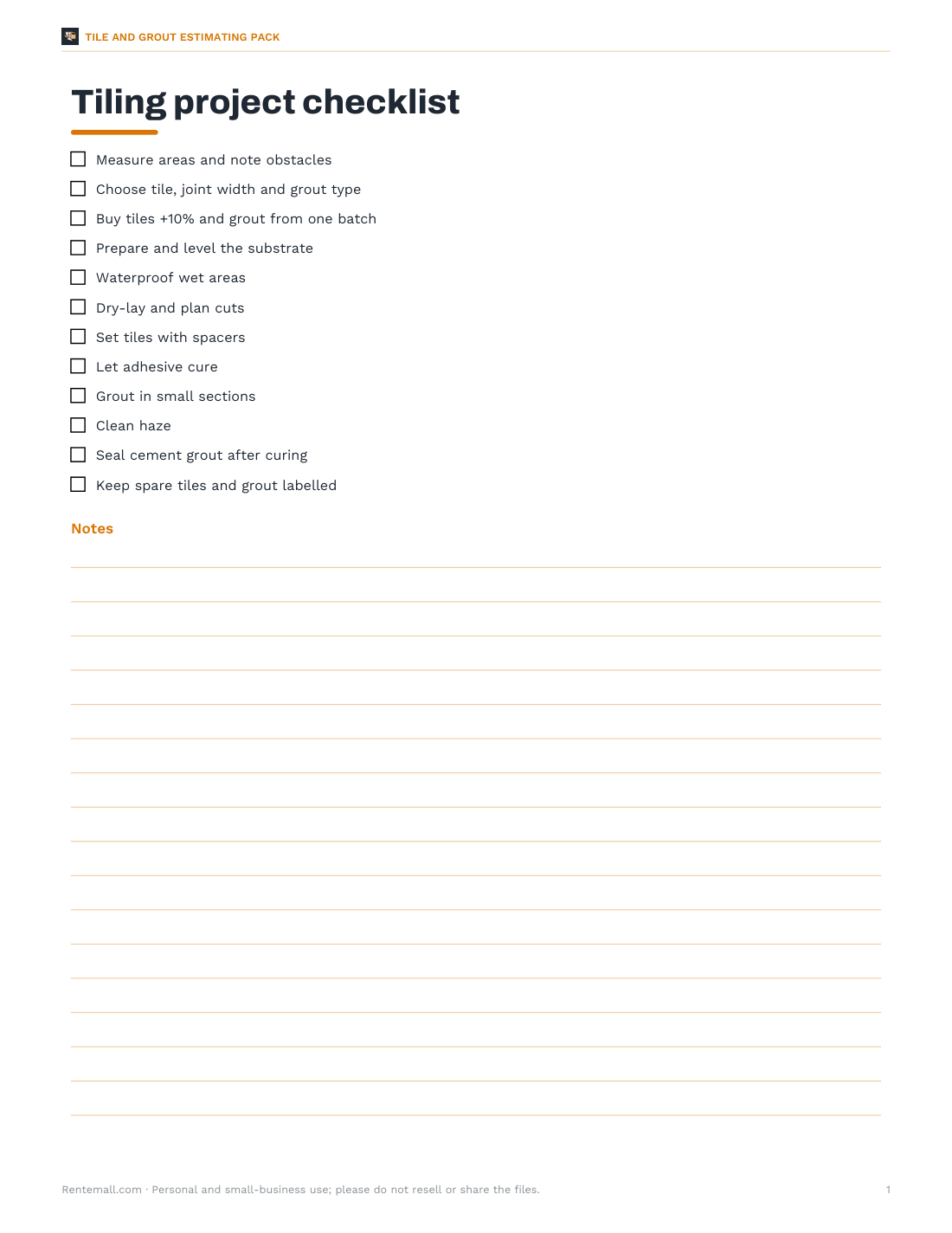
- Tiling checklist (PDF/DOCX)
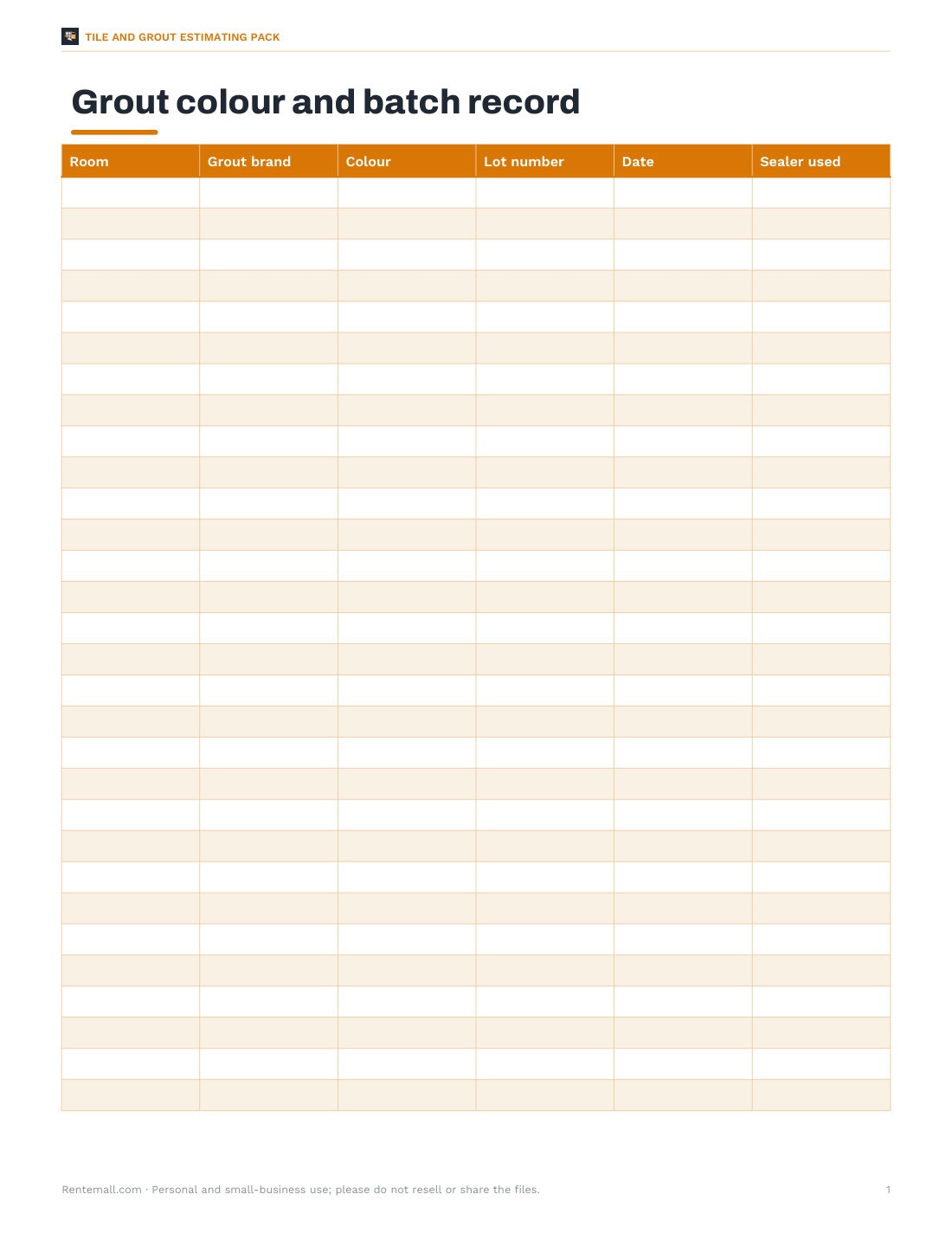
- Grout record (PDF/DOCX/XLSX)
- Cost log (PDF/DOCX/XLSX)
Formats: XLSX, PDF, DOCX. Instant download after payment (link valid 72 hours, up to 5 downloads). AI-assisted: the templates were drafted with AI help and reviewed and laid out before publishing.
$5.00 USD, one-time 4 files · about $1.25 each
- Instant download
- 7-day refund
- Secure checkout by Stripe
7-day money-back guarantee. Full refund within 7 days of purchase, even after you download.
Free sample: Tile and Grout Estimator (PDF, 50 KB)
Full refund within 7 days — see the refund policy and license.
Free printables
Single sheets you can print right now, no sign-up. The full pack adds every sheet in one download plus the editable files.
 Printable Grout Calculator Sheet
 Printable Tiling Checklist
 Printable Grout Record Sheet
 Printable Tiling Cost Log
The grout formula
Grout fills the joints between tiles, so the amount depends on the total length of joint and its cross-section. Per unit area, the joint length is (tile length + tile width) ÷ (tile length × tile width). Multiplying by joint width and depth gives the volume, and multiplying by the grout’s density gives the weight. In metric units: kg per m² = (L + W) ÷ (L × W) × joint width × joint depth × density, with tile sizes and joints in millimetres and a density of about 1.6 kg per litre for cement grout. Epoxy grouts are a little denser.
Coverage for common tiles
| Tile | Thickness | Joint | Approx. per 100 sq ft (lb, before waste) |
|---|---|---|---|
| 1 × 1 in mosaic | 1/4 in | 1/16 in | 26 |
| 2 × 2 in mosaic | 1/4 in | 1/8 in | 26 |
| 3 × 6 in subway | 5/16 in | 1/16 in | 8 |
| 4 × 4 in | 1/4 in | 1/8 in | 13 |
| 6 × 6 in | 3/8 in | 1/8 in | 13 |
| 12 × 12 in | 3/8 in | 1/8 in | 7 |
| 12 × 24 in | 3/8 in | 1/8 in | 5 |
| 24 × 24 in | 3/8 in | 1/16 in | 2 |
| Natural stone 12 × 12 in | 1/2 in | 1/4 in | 17 |
These figures come from the formula with a cement grout density of 1.6 kg/L. Mosaics need far more grout per square foot because there are many more joints. Add 10–20% for waste, spills and grout left in the bucket.
Choosing joint width
| Joint | Typical use |
|---|---|
| 1/16 in (1.5 mm) | Rectified porcelain and large-format tiles with very consistent edges |
| 1/8 in (3 mm) | Most wall and floor tiles |
| 3/16 in (5 mm) | Floor tiles with slight size variation |
| 1/4 in (6 mm) and wider | Handmade tiles, rustic stone, terracotta |
Tile manufacturers often recommend a minimum joint based on the tile’s size variation. Very tight joints on non-rectified tiles make uneven edges more noticeable.
Sanded, unsanded and epoxy grout
| Grout | Joint width | Notes |
|---|---|---|
| Unsanded | Under 1/8 in (3 mm) | Smooth; good for polished stone and glass that sand could scratch |
| Sanded | 1/8 in (3 mm) and wider | Sand adds strength and resists shrinking and cracking |
| Epoxy | Most widths — check the product | Stain-resistant, no sealing needed; harder to work with and cures quickly |
| Urethane / premixed | Varies | Ready to use, flexible; follow the product’s limits |
Worked example
A 100 sq ft bathroom floor uses 12 × 12 in porcelain tiles 3/8 in thick with 1/8 in joints. In millimetres: (304.8 + 304.8) ÷ (304.8 × 304.8) × 3.175 × 9.525 × 1.6 ≈ 0.318 kg/m². The floor is 9.29 m², so it needs about 2.95 kg, or 6.5 lb, before waste. With 15% waste that’s about 7.5 lb — a single 10 lb bag. The same floor in 2 × 2 in mosaics with 1/8 in joints and 1/4 in thickness would need around 26 lb before waste — two 25 lb bags once waste is added.
Buying and mixing tips
- Buy all the grout from the same batch (lot number) so the colour is consistent.
- Mix only as much as you can use within the working time on the bag, often 20–30 minutes.
- Use the water ratio on the bag; extra water weakens grout and can cause colour variation.
- Keep a small amount for future repairs, labelled with the colour and lot.
- Wait for tile adhesive to cure (often 24 hours) before grouting.
Grout colour choices
- A grout close to the tile colour makes joints disappear and the surface look larger.
- A contrasting grout emphasises the tile shape — popular with white subway tiles and dark grout.
- Mid-grey and beige hide dirt better than white on floors.
- Colours can dry lighter or darker than they look wet; make a sample board first.
- Colour-consistent products and epoxy grouts show less variation than traditional cement grout.
Sealing and aftercare
Most cement grouts are porous and benefit from a penetrating sealer once fully cured — often after 48–72 hours, but follow the product instructions. Epoxy grout doesn’t need sealing. Clean with pH-neutral cleaners; acidic and bleach-based cleaners can etch grout and stone.
The estimating pack
The optional pack includes an Excel tile and grout estimator for several rooms at once (tiles, adhesive and grout with waste), a printable tiling checklist, a grout colour and batch record sheet and a project cost log. The calculator on this page is free.
AI-assisted content
This page was drafted with AI assistance and reviewed before publishing. Always check the grout manufacturer’s coverage chart for your product.
Frequently asked questions
How much grout do I need for 100 square feet?
For 12 × 12 in tiles with 1/8 in joints, about 7–8 lb including waste; mosaics need much more.
How do I calculate grout?
kg/m² = (L + W) ÷ (L × W) × joint width × depth × density (about 1.6 for cement grout), with sizes in mm.
When should I use sanded grout?
For joints 1/8 inch (3 mm) and wider.
Why do mosaics need so much grout?
Small tiles mean many more joints per square foot.
How much extra grout should I buy?
Add 10–20% for waste and keep a little for repairs.
Does joint depth matter?
Yes — it is usually the tile thickness, and grout volume scales directly with it.
Can I use leftover grout later?
Mixed grout can’t be saved, but unopened powder keeps if stored dry; note the colour and lot for repairs.